



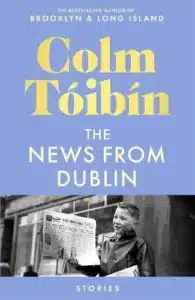
 Unsurprisingly, I jumped at the chance to review Colm Tóibín’s The News from Dublin when it was offered particularly as it’s published in Cathy’s Reading Ireland Month over at 746 Books. The nine stories comprising the collection range from Ireland to Argentina, Spain to Texas, spanning the early twentieth century to the present day. As ever with short stories, I’ve picked out favourites (more of a challenge than usual) giving the longest piece a paragraph of its own.
His dying meant that she would no longer have to judge him. Death would simplify him and that at least was something.
The opening story, The Journey to Galway, is set in the final year of World War One, as a mother carries the news of her airman son’s death to his wife, contemplating the years that came before and the significance of his death in a war about empire, gradually revealing her son’s bad behaviour. The News from Dublin sees Maurice Webster hoping to use his family’s Civil War contacts to gain access to a new drug which may save his brother in the days when tuberculosis was a death sentence. Barton Springs, the shortest piece, and my favourite, sees a man remembering the unconscious beauty of another in the swimming pool changing rooms in the town where grief for his brother hit hard, many years ago. In A Sum of Money, a young boy sent to boarding school thanks to the generosity of his uncle, becomes devious and dishonest in his attempts to avoid the ridicule of classmates from wealthy families.
I think about the city I used to know, which was a place that specialized in the half-said thing, the shrug, a place where people looked at one another out of the corner of their eye.
The almost novella length The Catalan Girls sees Montse, the youngest of three sisters taken to live in Argentina by their widowed mother fifty years before, make a momentous decision when she learns of their Aunt Julia’s death and the house she’s left her nieces in the Pyrenees. Distant from each other for years, the sisters decide to spend the summer in their aunt’s village, Núria taking charge, just as she always did, Conxita dallying with a sculptress while Montse sets about putting her plan into action, fading into the background while her sisters involve themselves in local life, leaving her uncertain of the wisdom of her decision.
She thought of all the things they knew that she did not know. So much had happened in her long absence, things people were hardly even aware they remembered. Not knowing them meant she was alone, sitting outside the circle.
Tóibín’s collection explores loss, loneliness, grief and the meaning of home in characteristically meticulously crafted, understated prose. Some address difficult themes – the claustrophobic A Free Man takes us inside the head of a quietly unrepentant abuser who leaves the country rather than face ignominy when his sentence is up – others imagine a return home to something very different from what was left behind. History underpins many of these stories, from the woman faced with her past when one of Franco’s generals offers to help a local historian, threatening to upend the compromise she made fifty years ago, to Maurice Webster’s sighting of de Valera in the Dáil, still upright and imposing. An impressive collection which leaves readers with much to think about.
Picador Books: London 9781035030736 272 Hardback (Read via NetGalley)
Discover more from A Life in Books
Subscribe to get the latest posts sent to your email.
Brilliant. I must read this!
It’s such a treat!
I don’t need to be asked twice to look out for this. With the Pyrenees and Catalan interest as added inducements for me.
I’ve just read this for Reading Ireland Month as well and enjoyed it. I particularly liked The Journey to Galway and Five Bridges, but all of the stories were interesting and I agree that there were no duds!