



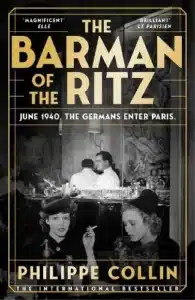
 Based on real life figures, Philippe Collin’s The Barman of the Ritz isn’t an obvious choice for me, but I’ve enjoyed several novels translated by Frank Wynne so decided to give it a try. Collin reimagines bartender Frank Meier’s four years at the Parisian hotel during the Occupation, from 1940 to Liberation in August of ’44.
France has dissolved like a lump of sugar in a glass of absinthe.
The child of Polish Jews, Frank set up the Petit Bar in 1921, learning his trade in New York to which he’d made his way aged just fourteen. He’s a veteran of the Great War, fighting for the French under General Pètain, despite his Austrian citizenship, revealing his Jewish heritage to no one. By the time the Nazis arrive, Frank is renowned, even writing a book at the suggestion of F Scott Fitzgerald who he knew well enough to call a friend. Marie-Louise Ritz takes full advantage of her Swiss citizenship, keeping the hotel open as an island of neutrality while indulging the likes of Göring and his henchmen. Frank swallows his scruples, charming the German officers who frequent his bar while keeping an eye on his young Jewish apprentice for who he’s arranged false papers. Georges, his assistant and fellow veteran, quickly adjusts to this new life, placing his faith in Pètain’s Vichy administration. Over the years of Occupation, the luxurious world of the Ritz is an increasingly jarring contrast with the starvation and misery outside its doors. Frank becomes involved in a scheme to help wealthy Jewish families escape, his anxiety mounting that his own identity will be revealed and that the recklessness of the woman he adores will be the death of her. By the time the Allies arrive, he no longer recognises himself as he readies the bar to receive a new set of officers.
One day, he finds himself doing favours for Nazis, the next, he is helping Jewish families escape.
That subtitle is taken from Collin’s author’s note. It’s one I’ve asked myself when thinking about the Occupation and collaboration, perhaps understandably not much written about until comparatively recently. It’s a morally complex time which Collin explores well through Frank and his circumstances, from the naked exploitation by the ‘Widow’, as he dubs Marie-Louise, and the staff’s greed for tips, to Frank’s arrangement of false papers, at first pragmatic then to ease his conscience and out of concern while also making money. Collin spent seven years researching the background for Frank’s story which is backed up with an appendix, a gallery of the main protagonists and their fates after Liberation. He leaves Frank on the 9th August 1944, with Hemmingway’s legendary entrance to the bar. The real Frank died three years later in slightly murky circumstances. It’s a gripping story, well told, its suspense maintained even though we know the ending. Collin’s description of a Paris suffering the depredations of Occupation, and worse, was particularly resonant for me given my visit to the city earlier this year which took me just metres away from the famous hotel.
Doubleday: London 9781529956399 368 pages Hardback (NetGalley)
Discover more from A Life in Books
Subscribe to get the latest posts sent to your email.
Sounds really interesting!
Definitely a step outside my usual reading but it’s well done and leaves you with lots to think about.
How interesting. I reserved this from the library and when it came, my husband read it. He was underwhelmed, found it hard going (‘though it got better’). Because I had 9 (!) other books that had just come in, I took the line of least resistance, and took it back, unread by me. Our time in France has made us very interested in the Resistance, which has cast a long shadow. In small communities, neighbours still remember which side each was on, and we lived near some of the well-trodden escape routes over the Pyrenees. I’m re-reserving it! Recommended also is Edward Stourton’s ‘Cruel Crossing: Escaping Hitler across the Pyrenees’.
Thanks for the recommendation. Easy to take the moral high ground for those lucky enough not to have suffered invasion. Enthusiastic collaborators are easier to judge, although who knows the circumstances. I’m sure it’s the same in Spain given the civil war. I hope you get on with it better than your husband.
Frank Wynne is one of my favourite translators. This sounds a fascinating novel, given so much of it happened.
Definitely a name I look out for. I’d recommend this one, a tricky subject handled well.