



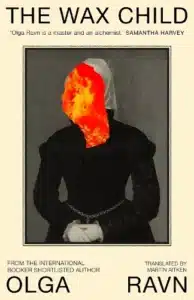
 Set in seventeenth-century Denmark, Olga Ravn’s The Wax Child grew out of HEX, her play which premiered at the Royal Danish Theatre in 2023. It’s narrated by the titular wax child moulded by Christenze Kruckow, an impoverished noblewoman charged with witchcraft.
Is that what harmful magic is? The thing everyone did to stop the hiccups? Was that heresy? Forgive us. We knew so little about the Devil in those days, now everyone knows so much about him.
Christenze lives in the household of her friends Anne and Einar Bille. She helps with the birthing of Anne’s many children, none of whom survive more than a few days. Over the years, Anne’s hope turns to a bitterness which needs a target, conveniently provided by Christenze whose pride in her unmarried independence is already barely tolerated. Christenze flees before accusations are voiced, finding a home in Aalborg where Maren welcomes her into her circle of friends. They work together carding linen and preparing herring, a closeknit community who do what they can to protect the pastor’s wife whose husband regularly beats her. When one of their husbands witnesses the women’s celebration of St Lucia’s Eve, his suspicions lead him to the local King’s Lieutenant, little realising the horrors he is about to unleash. Evidence is gathered and paid for, torture administered, confessions extracted, convictions declared and the cruellest of punishments handed down.
They consulted their books of demonology, and there read: The woman is more easily tempted by Satan, for she is weaker than the man in both body and soul. And they read: The woman is a wicked and imperfect animal. When a woman weeps she weaves snares, and labours to deceive a man.
Ravn’s narrative is delivered in short episodic paragraphs interspersed with spells drawn from sources she used in her research for this brief, powerful novella based upon the trials of Christenze Kruckow, her friends and many other women in seventeenth-century Denmark. Witchcraft is a theme that has interested me for some time, a way for people to explain the misfortunes that befell them by pointing the finger at women living less conventional lives, often midwives and healers – although not in this case – who present a threat to the established order with the power that knowledge brings, arousing fear and misogyny. Christenze is such a figure, an easy target, although perhaps an unusual one given her nobility. The figure she’s moulded from beeswax, incorporating hair and nail parings, gives her motives an interesting ambivalence. Using it as a narrator is a risky device, but it works well, a testament to Ravn’s skill. In less able hands, her subject might have become sensationalist, but she does her readers the courtesy of allowing them to infer, and, as you might expect from a poet, her writing is arrestingly vivid. Kudos to Martin Aitken for his expert translation.
Viking: London 9780241752746 144 pages Hardback (read via NetGalley)
Discover more from A Life in Books
Subscribe to get the latest posts sent to your email.
Intriguing. Ordered from the library (to go with the 11 already on order, and the 8 loans I have currently …)
You’ll be pleased to hear it’s a novella!
I gathered as much! Novellas are currently my friends.
I read this a couple of weeks ago and was quite impressed As you say, Ravn’s a (very) talented writer (her background as a poet really enriches this novel; the language & descriptions are generally quite lovely); the translation’s great and the novel’s narrative structure original, to say the least. Have you read Ravn’s The Employees? It’s another Martin Aitkin translation and just as wildly imaginative as The Wax Child.
The Employees is published here in the UK in paperback tomorrow so I’ll be buying it shortly. Pleased to hear that it’s as imaginative as this one. She’s clearly very talented as is Aitkin.
I read The Employees a while back and really enjoyed it. This appeals a lot,
Very keen to read that, Cathy. I was very struck by this one.
I’ve just ordered it!
Hurrah!
I’m glad you got more out of this than I did – I really struggled with the dense prose, despite admiring her evocation of the historical period.
Thanks. It did take me some time to get used to it.
This does sound intriguing, and some brave choices in style. Like you I’m interested in witches – certainly a rich theme to explore.
It is, indeed. The style is quite challenging but worth persevering. Her writing is quite beautiful at times.
Just bought a copy. The translator also translates Hanne Østravik (so?!). Such a striking cover design. Looking forward!
Ah, I hadn’t made that connection. He does a brilliant job with both. I hope you enjoy it, Jennifer.