



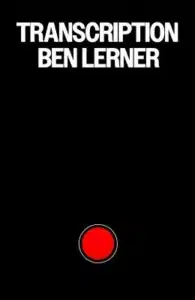
 I reviewed Ben Lerner’s novella 10:04 here over a decade ago, commenting on its many-layered interconnections, impossible to encapsulate in a short post. Since then, I’ve read Leaving the Atocha Station which brought him a great deal of acclaim although, for me, it didn’t match 10.04. Divided into three parts, Transcription is another brief novel which contains a multitude of ideas and themes following our unnamed narrator who sets out to interview his mentor but has a mishap.
I carried it in my palm like a small, wounded animal back into the bathroom and removed the wall-mounted hairdryer from its charger.
Our narrator has returned to Provincetown to interview Thomas, his revered mentor during his student years and the father of his friend Max. Thomas has just turned ninety. This will likely be his last interview. Adding to his anxieties about his daughter who seems on the point of refusing to go to school, our narrator frets about whether his phone will record, knowing that Thomas’s disdain for technology means there will be no backup. Just before he leaves, he knocks it into the basin of water he’d been using to wash his face, setting off fretfully to his mentor’s house where he finds Thomas disconcertingly off kilter. Some time later, having given a keynote speech about his late mentor, prefaced with the amusing anecdote about his phone, he finds himself reproached for his dishonesty in publishing Thomas’s last public testament having not recorded it. In the third episode, Max talks to our narrator about his difficulties with his father and the anxiety of raising a daughter in a world which has changed almost beyond recognition.
I was having an unusual experience of presence – more aware of silicates glittering in the asphalt, the little plumes of vapour that were my breath, the articulation of branches and their shadows on the sidewalk – but I was also walking into my past, because this was a landscape so dense with formative memories and events, and because only in the past would I be deviceless.
Characteristically cerebral and discursive, Transcription examines parenthood, technology, memory and relationships between fathers and sons. Lerner is the same age as our narrator, sharing his love of Madrid, suggesting a degree of autofiction that typified his previous novels, but this felt much more personal than 10:04, a working out of ideas. The exploration of our devices’ influence, our slavish dependence on them, is particularly well done, a genie which can’t be forced back in the bottle. The fraught anxieties of modern parenthood contrast with the dysfunction of Max’s relationship with Thomas, his outpouring of things unsaid when he’s told to say goodbye by an ICU medic during lockdown. Memory and its unreliability, in ageing or otherwise, runs through Lerner’s narrative, unsettlingly so, particularly at its end. Not an easy book to write about – I’ve barely scratched the surface of what it has to say – but certainly an impressive one.
Granta Books: London 9781803513805 144 pages Hardback (Read via NetGalley)
Discover more from A Life in Books
Subscribe to get the latest posts sent to your email.
Somehow, I’ve dodged Ben Lerner as an author. You’ve definitely made me feel I’ve missed out.
He’s an acquired taste. I’m glad I started with 10.04 as Leaving the Atocha Station really didn’t do it for me.
Do you suggest I start with 10.04 perhaps then?
It’s my favourite of the three. I have reviewed it on the blog if you want to check that.
I’ll pop back in a bit. Thanks!
Mmmm … I’ve tried to find what it is about “Transcription” that makes it special, but, have to admit, it came across as a very contrived piece of writing to me. Perhaps I should blame myself. Maybe it just went over my head, though I doubt it …
I suspect readers divide into those who enjoy his style and those who really don’t.
I tried Atocha Station and 10:04 and couldn’t get into either. Would this be a good one to try again with Lerner?
It’s stylistically similar, Annabel, which makes me think it wouldn’t work for you.
I read Atocha Station way back and I think I liked it? This does appeal (the short length helps!) as does 10.04
I think you need to click with his discurisve style to enjoy it. Leaves you with lots to think about.
I see this book getting good reviews in other places. Is it a plot driven book, or more philosophical in tone?
Definitely not plot-driven, Lucy. It’s very much a discursive working out of ideas. I’m glad it’s being well reviewed.
The themes here are so interesting, you’ve definitely made it sound appealing. But I appreciate the style can be a bit alienating.
Well worth trying if you’re prepared for the style.
I havne’t read this new one and, honestly, can’t ever remember exactly what/which I’ve read, maybe because, as you say, there’s a consistent voice throughout. But, having said that, I know that I haven’t read The Topeka School and always thought it might be a little off that path…
That’s the one I haven’t read! I do think his style is an acquired taste but I’m quite partial to a bit of discursiveness.
I’ve read all Lerner’s previous novels, and agree that 10:04 is the best (and is in fact the book I am reading in my very old Goodreads profile photo!). He’s a novelist I always think I’ll dislike but I’ve ended up finding all his books so far rewarding. Hopefully this one will be the same.
Oooh, I’ll check that out! Hope you enjoy this one, too. I think you probably will.