



Having written a couple of these posts on Irish fiction, it’s time for a few Scottish favourites, some written in such rich dialect I could hear it as I read. There’s a real skill to that kind of writing as anyone who’s read a cringe-makingly poor version 
Anne Donvan’s Buddha Da is a fine example of dialect executed so brilliantly that Jimmy McKenna’s voice was in my head for quite some time after I’d finished it. Working-class, Glaswegian and proud of it, Jimmy becomes interested in Buddhism after chatting to a monk in a café. He’s a painter and decorator, a bit of an unlikely convert but soon he’s off on weekend retreats much to the bemusement of his family. Donovan unfolds the story from the point of view of Jimmy, his wife and their eleven-year-old daughter both of whom struggle with the concept of Jimmy’s newfound fervour after years of self-professed atheism not to mention drunken high-jinks. Donovan’s novel is very funny at times but has serious things to say about tolerance and the way we lead our lives.
Louise Welsh’s The Cutting Room keeps us in Glasgow where Bowery Auctions is close to bankruptcy when its auctioneer is offered an opportunity that will
Moving away from Glasgow, Jenni Fagan’s Luckenbooth tells the stories of the inhabitants of a many-floored Edinburgh
 Unlike the previous four novels, Kirstin Innes’s Scabby Queen takes us all over the place, from the Scottish Highlands to the Genoa G8 protests, as it explores over three decades of political protest through the story of Clio Campbell, firebrand and erstwhile rock star, who takes her own life just three days before her fifty-first birthday. Clio’s appearance on Top of the Pops displaying her politics to the world as she unbuttons her shirt to reveal a close-fitting T-shirt bearing an anti-poll tax slogan, is the zenith of her career, enshrined in popular culture. While her musical influence wanes her passion for justice continues to shine brightly until she chooses the ultimate political act. Written with wit, humour and sharp observation, this long, sprawling novel is the antithesis of the pared back, tightly disciplined writing I so admire, but I loved it.
Any favourite Scottish you’d like to share? I have plans for a Welsh post soon.
If you’d like to explore more posts like this, I’ve listed them here.
Discover more from A Life in Books
Subscribe to get the latest posts sent to your email.
I haven’t ready any of these though Shuggie Bain is occupying a place on my to-be-read corridor (which I hurdle to get into bed). The last Scottish novels I read were His Bloody Project by Graeme Macrae Burnet and The Bookseller of Inverness by SG MacLean which were both really enjoyable.
Now, here’s an image to conjure with! I know the Burnet but not MacLean. Thanks!
All of these sound interesting. My most recent foray into Scotland was Clear by Carys Davies. Non-fiction book I really liked was Motherwell by Deborah Orr.
The Davies will be on my Welsh list despite that Scottish setting! Thanks for reminding me of Motherewell and of Deborah Orr, a sad loss.
A foot in both countries! Orr was such a loss indeed. Another beautiful book is Nairn, In Darkness and Light. By the Scottish writer David Thomson. A classic as far as I am concerned.
Indeed, and thanks for the Nairn recommendation. Definitely one for the list!
I have Shuggie in my pile. I really need to get to it
Keep some tissues handy!
It’s been years since I read Buddha Da, but I remember loving it.
I agree the two Rilke novels were great, not my usual read but I thought they were really well done.
As you know, I thought That Beautiful Atlantic Waltz was great, so that was the Scottish read that immediately came to mind as one I would recommend!
Waltz will definitely be on my second Scottish list. Have to get to the Welsh first, though. I spotted that that there’s a third Rilke in the offing next year. Not sure how I feel about that.
Interesting! I hope she sustains how good they are. Fingers crossed!
Absolutely! I was wary enough about the sequel.
I loved The Cutting Room!
Wasn’t it superb? I gather Rilke’s getting a third outing next year.
Excellent!
Having just read The Master of Ballantrae and now Clear, I seem to be in Scotland a lot at the moment but I haven’t read any of these not even Shuggie Bain -looking forward to your Welsh post now!
Not a bad place to visit! I’d recommend Shuggie, although best read when feeling cheerful.
I keep meaning to read Buddha Da from the library as it was on the Orange (Women’s) Prize shortlist and I’m vaguely working my way through all the nominees.
Tom Newlands’ Only Here, Only Now (our McKitterick Prize winner) captured the voice of a Scottish teen girl very well.
That’s an interesting project. I have the Newlands on my list already. I think I must have picked it up when you wrote about the McKitterick.
I’m ashamed to admit I’ve only read one of these – Luckenbooth, which sadly didn’t work for me as well as it did for you. I must read Buddha Da sometime though – it feels as if it’s been on my radar for ever!
That’s a shame. I think you’re a Glaswegian so I hope that dialogue works for you if you do get around to the Donovan.
Louise Welsh is such a good writer, I read both The Cutting Room and The Second Cut, but I don’t think I’m going to read her Naming the Bones. They’re a bit too dark for me. That said, her Tamburlaine Must Die is one of my all-time favorite books – just marvelous, and a novella.
Tamburlaine was quite a departure from The Cutting Room, wasn’t it. Keeping my fingers crossed for Rilke’s third appearance.
I loved Shuggie Bain. Didn’t read this second one. The Cutting Room sounds really good! I have a feeling, though, some of it must be hard to read.
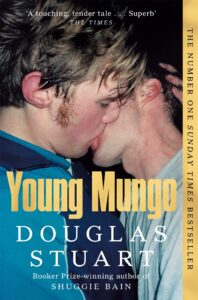
I’m sure you’d love Young Mungo if you enjoyed Shuggie. Highly recommend The Cutting Room. Rilke is an unforgettable narrator.
Thank you … I’ve reserved a copy of The Cutting Room at the library.
I guess I don’t read many Scottish writers, but I’ve heard the first two writers read at festivals and had intended to read both those books (but, you know, it doesn’t always actually happen). The most recent might be the classic Scot’s Quair, which I was a little surprised to really love (I’d thought it would be most enjoyable if one had been to Scotland but it’s so tremendously universal thematically).
That’s quite a classic, isn’t it. Perhaps I should give it a try.